Thursday, June 26, 2008

Leaning Tower of Pisa

The Leaning Tower of Pisa (Italian: Torre pendente di Pisa) or simply The Tower of Pisa (La Torre di Pisa) is the campanile, or freestanding bell tower, of the cathedral of the Italian city of Pisa. It is situated behind the Cathedral and it is the third structure by time in Pisa's Piazza del Duomo (Cathedral Square).

Although intended to stand vertically, the tower began leaning to the southeast soon after the onset of construction in 1173 due to a poorly laid foundation and loose substrate that has allowed the foundation to shift direction. The tower presently leans to the southwest.

The height of the tower is 55.86 m (183.27 ft) from the ground on the lowest side and 56.70 m (186.02 ft) on the highest side. The width of the walls at the base is 4.09 m (13.42 ft) and at the top 2.48 m (8.14 ft). Its weight is estimated at 14,500 tonnes. The tower has 296 or 294 steps; the seventh floor has two fewer steps on the north-facing staircase. The tower leans at an angle of 3.97 degrees[1]. This means that the top of the tower is 3.9 meters from where it would stand if the tower were perfectly vertical

Construction

The Tower of Pisa was a work of art, performed in three stages over a period of about 177 years. Construction of the first floor of the white marble campanile began on August 9, 1173, a period of military success and prosperity. This first floor is surrounded by pillars with classical capitals, leaning against blind arches.

The tower began to sink after construction progressed to the third floor in 1178. This was due to a mere three-meter foundation, set in weak, unstable subsoil. This means the design was flawed from the beginning. Construction was subsequently halted for almost a century, because the Pisans were almost continually engaged in battles with Genoa, Lucca and Florence. This allowed time for the underlying soil to settle. Otherwise, the tower would almost certainly have toppled. In 1198, clocks were temporarily installed on the third floor of the unfinished construction.

In 1272, construction resumed under Giovanni di Simone, architect of the Camposanto. In an effort to compensate for the tilt, the engineers built higher floors with one side taller than the other. This made the tower begin to lean in the other direction. Because of this, the tower is actually curved.[3] Construction was halted again in 1284, when the Pisans were defeated by the Genoans in the Battle of Meloria.

The seventh floor was completed in 1319. The bell-chamber was not finally added until 1372. It was built by Tommaso di Andrea Pisano, who succeeded in harmonizing the Gothic elements of the bell-chamber with the Romanesque style of the tower. There are seven bells, one for each note of the musical scale. The largest one was installed in 1655.

After a phase (1990-2001) of structural strengthening, the tower is currently undergoing gradual surface restoration, in order to repair visual damage, mostly corrosion and blackening. These are particularly strong due to the tower's age and to its particular conditions with respect to wind and rain.

The architect

There has been controversy about the real identity of the architect of the Leaning Tower of Pisa. For many years, the design was attributed to Guglielmo and Bonanno Pisano [5], a well-known 12th-century resident artist of Pisa, famous for his bronze casting, particularly in the Pisa Duomo. Bonanno Pisano left Pisa in 1185 for Monreale, Sicily, only to come back and die in his home town. His sarcophagus was discovered at the foot of the tower in 1820. However recent studies[6] seem to indicate Diotisalvi as the original architect due to the time of construction and affinity with other Diotisalvi works, notably the bell tower of San Nicola (Pisa) and the Baptistery in Pisa. However, he usually signed his works and there is no signature by him in the bell tower which leads to further speculation.

History

Galileo Galilei is said to have dropped two cannon balls of different masses from the tower to demonstrate that their descending speed was independent of their mass. This is considered an apocryphal tale, and the only source for it comes from Galileo's secretary.[7]

In 1934 Benito Mussolini ordered that the tower be returned to a vertical position, so concrete was poured into its foundation. However, the result was that the tower actually sank further into the soil.[8]

During World War II, the Allies discovered that the Nazis were using it as an observation post. A U.S. Army sergeant was briefly entrusted with the fate of the tower. His decision not to call in an artillery strike saved the edifice.[8]

On February 27, 1964, the government of Italy requested aid in preventing the tower from toppling. It was, however, considered important to retain the current tilt, due to the vital role that this element played in promoting the tourism industry of Pisa. [9] A multinational task force of engineers, mathematicians and historians was assigned and met on the Azores islands to discuss stabilization methods. It was found that the tilt was increasing due to the stonework expanding and contracting each day due to the heat of sunlight[10]. This was working in combination with the softer foundations on the lower side. Many methods were proposed to stabilize the tower, including the addition of 800 metric tons of lead counterweights to the raised end of the base.[11]

On 7 January 1990, after over two decades of work on the subject, the tower was closed to the public. While the tower was closed, the bells were removed to relieve some weight, and cables were cinched around the third level and anchored several hundred meters away. Apartments and houses in the path of the tower were vacated for safety. The final solution to prevent the collapse of the tower was to slightly straighten the tower to a safer angle, by removing 38 m3 of soil from underneath the raised end. The tower was straightened by 18 inches (45 centimetres), returning to the exact position that it occupied in 1838. After a decade of corrective reconstruction and stabilization efforts, the tower was reopened to the public on December 15, 2001, and has been declared stable for at least another 300 years.[11]

In 1987, the tower was declared as part of the Piazza dei Miracoli UNESCO World Heritage Site along with neighbouring cathedral, baptistery and cemetery.

In May 2008, after the removal of another 70 tonnes of earth, engineers announced that the Tower had been stabilized such that it had stopped moving for the first time in its history. They stated it would be stable for at least 200 years.[12]

Technical information

* Elevation of Piazza dei Miracoli: about 2 metres (6 feet, DMS)
* Height: 55.863 metres (183 ft 3 in), 8 stories
* Outer diameter of base: 15.484 m
* Inner diameter of base: 7.368 m
* Angle of slant: 3.97 degrees[18] or 3.9 m from the vertical[19]
* Weight: 14,700 tonnes
* Thickness of walls at the base: 8 ft (2.4 m)
* Total number of bells: 7, tuned to musical scale, clockwise
o 1st bell: L'assunta, cast in 1654 by Giovanni Pietro Orlandi, weight 3,620 kg (7,981 lb)
o 2nd bell: Il Crocifisso, cast in 1572 by Vincenzo Possenti, weight 2,462 kg (5,428 lb)
o 3rd bell: San Ranieri, cast in 1719-1721 by Giovanni Andrea Moreni, weight 1,448 kg (3,192 lb)
o 4th bell: La Terza (1st small one), cast in 1473, weight 300 kg (661 lb)
o 5th bell: La Pasquereccia or La Giustizia, cast in 1262 by Lotteringo, weight 1,014 kg (2,235 lb)
o 6th bell: Il Vespruccio (2nd small one), cast in the 14th century and again in 1501 by Nicola di Jacopo, weight 1,000 kg (2,205 lb)
o 7th bell: Dal Pozzo, cast in 1606 and again in 2004, weight 652 kg (1,437 lb) [20]
* Steps to bell tower: 296[21]

A special note on the 5th bell: The name Pasquareccia comes from Easter, because it used to ring on Easter day. However, this bell is older than the bell-chamber itself, and comes from the tower Vergata in Palazzo Pretorio in Pisa, where it was called La Giustizia (The Justice). The bell was tolled to announce capital executions of criminals and traitors, including Count Ugolino in 1289 [22] A new bell was transferred on the belltower to replace the broken Pasquareccia bell at the end of the 18th century.


Tuesday, June 24, 2008

Eiffel Tower

The Eiffel Tower (French: Tour Eiffel, /tuʀ ɛfɛl/) is an iron tower built on the Champ de Mars beside the Seine River in Paris. The tower has become a global icon of France and is one of the most recognizable structures in the world.

Information
Location Paris, France
Status Complete
Constructed 1887 – 1889
Use Observation tower
Radio broadcasting tower
Height
Antenna/Spire 324 metres (1,063 ft)
Roof 300.65 metres (986 ft)
Companies
Architect Gustave Eiffel
Structural
Engineer Gustave Eiffel

Introduction

Named after its designer, engineer Gustave Eiffel, the Eiffel Tower is the tallest building in Paris and one of the most recognized structures in the world.[1] More than 200,000,000 have visited the tower since its construction in 1889,[2] including 6,719,200 in 2006,[3] making it the most visited paid monument in the world.[4][5] Including the 24 m (79 ft) antenna, the structure is 325 m (1,063 ft) high (since 2000), which is equivalent to about 81 levels in a conventional building.

When the tower was completed in 1889 it was the world's tallest tower — a title it retained until 1930 when New York City's Chrysler Building (319 m — 1,047 ft tall) was completed.[6] The tower is now the fifth-tallest structure in France and the tallest structure in Paris, with the second-tallest being the Tour Montparnasse (210 m — 689 ft), although that will soon be surpassed by Tour AXA (225.11 m — 738.36 ft).

The metal structure of the Eiffel Tower weighs 7,300 tonnes while the entire structure including non-metal components is approximately 10,000 tonnes. Depending on the ambient temperature, the top of the tower may shift away from the sun by up to 18 cm (7 in) because of thermal expansion of the metal on the side facing the sun. The tower also sways 6-7 cm (2-3 in) in the wind.[3] As demonstration of the economy of design, if the 7300 tonnes of the metal structure were melted down it would fill the 125 meter square base to a depth of only 6 cm (2.36 in), assuming a density of the metal to be 7.8 tonnes per cubic meter. The tower has a mass less than the mass of the air contained in a cylinder of the same dimensions,[7] that is 324 meters high and 88.3 meters in radius. The weight of the tower is 10,100 tonnes compared to 10,265 tonnes of air.

The first and second levels are accessible by stairways and lifts. A ticket booth at the south tower base sells tickets to access the stairs which begin at that location. At the first platform the stairs continue up from the east tower and the third level summit is only accessible by lift. From the first or second platform the stairs are open for anyone to ascend or descend regardless of whether they have purchased a lift ticket or stair ticket. The actual count of stairs includes 9 steps to the ticket booth at the base, 328 steps to the first level, 340 steps to the second level and 18 steps to the lift platform on the second level. When exiting the lift at the third level there are 15 more steps to ascend to the upper observation platform. The step count is printed periodically on the side of the stairs to give an indication of progress of ascent. The majority of the ascent allows for an unhindered view of the area directly beneath and around the tower although some short stretches of the stairway are enclosed.

Maintenance of the tower includes applying 50 to 60 tonnes of paint every seven years to protect it from rust. In order to maintain a uniform appearance to an observer on the ground, three separate colors of paint are used on the tower, with the darkest on the bottom and the lightest at the top. On occasion the colour of the paint is changed; the tower is currently painted a shade of brownish-grey.[8] On the first floor there are interactive consoles hosting a poll for the colour to use for a future session of painting. The co-architects of the Eiffel Tower are Emile Nouguier, Maurice Koechlin and Stephen Sauvestre.[9]

History

The structure was built between 1887 and 1889 as the entrance arch for the Exposition Universelle, a World's Fair marking the centennial celebration of the French Revolution. Eiffel originally planned to build the tower in Barcelona, for the Universal Exposition of 1888, but those responsible at the Barcelona city hall thought it was a strange and expensive construction, which did not fit into the design of the city. After the refusal of the Consistory of Barcelona, Eiffel submitted his draft to those responsible for the Universal Exhibition in Paris, where he would build his tower a year later, in 1889. The tower was inaugurated on March 31, 1889, and opened on 6 May. Three hundred workers joined together 18,038 pieces of puddled iron (a very pure form of structural iron), using two and a half million rivets, in a structural design by Maurice Koechlin. The risk of accident was great, for unlike modern skyscrapers the tower is an open frame without any intermediate floors except the two platforms. However, because Eiffel took safety precautions, including the use of movable stagings, guard-rails and screens, only one man died.

The tower was met with much criticism from the public when it was built, with many calling it an eyesore. Newspapers of the day were filled with angry letters from the arts community of Paris. One is quoted extensively in William Watson's US Government Printing Office publication of 1892 Paris Universal Exposition: Civil Engineering, Public Works, and Architecture. “And during twenty years we shall see, stretching over the entire city, still thrilling with the genius of so many centuries, we shall see stretching out like a black blot the odious shadow of the odious column built up of riveted iron plates.”[10] Signers of this letter included Messonier, Gounod, Garnier, Gerome, Bougeureau, and Dumas.

Novelist Guy de Maupassant — who claimed to hate the tower — supposedly ate lunch in the Tower's restaurant every day. When asked why, he answered that it was the one place in Paris where you couldn't see the Tower. Today, it is widely considered to be a striking piece of structural art.

One of the great Hollywood movie clichés is that the view from a Parisian window always includes the tower. In reality, since zoning restrictions limit the height of most buildings in Paris to 7 stories, only a very few of the taller buildings have a clear view of the tower..

Eiffel had a permit for the tower to stand for 20 years, meaning it would have had to be dismantled in 1909, when its ownership would revert to the City of Paris. The City had planned to tear it down (part of the original contest rules for designing a tower was that it could be easily demolished) but as the tower proved valuable for communication purposes, it was allowed to remain after the expiration of the permit. The military used it to dispatch Parisian taxis to the front line during the First Battle of the Marne, and it therefore became a victory statue of that battle.

Shape of the tower

At the time the tower was built many people were shocked by its daring shape. Eiffel was criticised for the design and accused of trying to create something artistic, or inartistic according to the viewer, without regard to engineering. Eiffel and his engineers, as renowned bridge builders however, understood the importance of wind forces and knew that if they were going to build the tallest structure in the world they had to be certain it would withstand the wind. In an interview reported in the newspaper Le Temps, Eiffel said:
“ Now to what phenomenon did I give primary concern in designing the Tower? It was wind resistance. Well then! I hold that the curvature of the monument's four outer edges, which is as mathematical calculation dictated it should be (...) will give a great impression of strength and beauty, for it will reveal to the eyes of the observer the boldness of the design as a whole. ”

The shape of the tower was therefore determined by mathematical calculation involving wind resistance. Several theories of this mathematical calculation have been proposed over the years, the most recent is a nonlinear integral differential equation based on counterbalancing the wind pressure on any point on the tower with the tension between the construction elements at that point. That shape is exponential. A careful plot of the tower curvature however, reveals two different exponentials, the lower section having a stronger resistance to wind forces.

Installations

Since the beginning of the 20th century, the tower has been used for radio transmission. Until the 1950s, an occasionally modified set of antenna wires ran from the summit to anchors on the Avenue de Suffren and Champ de Mars. They were connected to long-wave transmitters in small bunkers; in 1909, a permanent underground radio centre was built near the south pillar and still exists today.[citation needed] On November 20, 1913, the Paris Observatory, using the Eiffel Tower as an antenna, exchanged sustained wireless signals with the United States Naval Observatory which used an antenna in Arlington, Virginia. The object of the transmissions was to measure the difference in longitude between Paris and Washington, D.C.[14]

The tower has two restaurants: Altitude 95, on the first floor (95 m, 311 ft, above sea level); and the Jules Verne, an expensive gastronomical restaurant on the second floor, with a private lift. This restaurant has one star in the Michelin Red Guide. In January 2007, a new multi-Michelin star chef Alain Ducasse was brought in to run Jules Verne.[15]

The uppermost observation deck, with a height of 275 metres, is the highest area of an architectural structure in the European Union open for the public.[citation needed]

The passenger lifts from ground level to the first level are operated by cables and pulleys driven by massive water-powered pistons. As they ascend the inclined arc of the legs, the elevator cabins tilt slightly, but with a slight jolt every few seconds, in order to keep the floor nearly level.[citation needed] The elevator works are on display and open to the public in a small museum located in one of the four tower bases.

Sunday, June 22, 2008

High Flaming Nature Park

High Fläming Nature Park (German: Naturpark Hoher Fläming) is a 827 km² nature park in Potsdam-Mittelmark district in the German state Brandenburg. It is the third largest of 11 nature parks in the state of Brandenburg. In 1997, it was declared a nature park by the State Minister for the Environment.

There is a visitor center in Rabenstein/Fläming offering information, an interesting exhibition, a bike rental and a shop with regional products.

Geography

The park is located about 80 km south of Berlin and Potsdam and covers the higher parts of the Fläming hill chain. The highest elevation is the Hagelberg (200,24 m). It borders in the south to the Fläming Nature Park in the state Saxony-Anhalt.

About 27.000 people are living in the area. Belzig is the central town in the park. Other towns in the Park include Wiesenburg/Mark, Görzke, Niemegk and Brück. The population density is 30 inhabitants per km².

About half of the area are forests, the other half is agricultural land. There are very few lakes, but there are some clear creeks and small rivers that are habitat for several protected species.

The Nature Park has very good traffic infrastructure: By car it can be reached using highway A 2 (Berlin-Hannover) (interchanges Ziesar (76), Wollin (77), Brandenburg (78)) or highway A 9 (Berlin - Leipzig) (interchanges Brück, Niemegk und Klein Marzehns). There is also a good railroad conncetion from Berlin, Potsdam and Dessau.

Landscape

The nature park is divided into two sections: In the south, the hilly and wooded landscape of the High Fläming and in the north a flat lowland, called "Belziger Landschaftswiesen" (Belzig landscape meadows). The more than 140,000-year-old heights are moraines.

The nature park area is about half wooded, and the other half is agricultural land. It is characterized by a constant change of forest and field. In some places, you will see the original beech forest. Open lakes and other water - apart from a few ponds - there are hardly any. However, there are many brooks, that are among the cleanest in Brandenburg and are very valuable for nature protection.

With the so-called "Rummeln", a form of dry valleys, the High Fläming has a unique botanical and geological feature.

Animals and plants

The Fläming is rich in wildlife (Fallow Deer, Red Deer, Raccoon Dog and the Mouflon). Among the most noteworthy species in the Nature Park are the Black Stork, the Common Noctule, a Microbat, and the Middle Spotted Woodpecker, the mascot of the nature parks. In the creeks the Brown Trout, the White-throated Dipper, the Brook lamprey and the European crayfish can be found. The Great Bustard and the Western marsh orchid are native to the lowlands.

Protected areas

Virtually the entire natural park area is a landscape protection area. The regulation on the landscape conservation area "Hoher Fläming und Belziger Landschaftswiesen" of 17 November 1997 became effective on 3 December 1997.

Moreover, there is in the nature park nine nature reserves. Some of the valuable Flämingbäche are protected (Lost water Bach, Bach bull Berger, Planetal), are also forest and moorland protected (Rabenstein, Spring, Werbiger Heide). Some nature reserves have been realized by the GDR. The nature protection areas (with the date of entry into force) are in the nature park:

* Bullenberger Bach / Briesener Bach (24 May 2003)
* Klein Marzehns (1 May 1961)
* Flämingbuchen (30 March 1961)
* Planetal (19 October 1967)
* Rabenstein (20 June 1978)
* Spring (17 March 1986)
* Verlorenwasserbach, Oberlauf (26 May 2005)
* Werbiger Heide (19 November 1999)
* Belziger Landschaftswiesen (24 May 2003)

Castles and palaces

Of particular interest are the four medieval castles in Fläming: Eisenhardt Castle in Belzig, Rabenstein Castle, Ziesar Castle and Wiesenburg Palace. In its present form Wiesenburg Palace is a neo-Renaissance building, but it was originally built as a medieval castle of which some elements are still preserved.

Presently there is a museum and a hotel in Eisenhardt Castle in Belzig.

Wiesenburg Palace is privately owned and is used for residential purposes. The castle tower can be visited and houses the tourist information of the community. The Palace has a park that is designed as a landscape park. The 123-hectare park is considered the most important park between Potsdam and the Dessau-Wörlitz Gardens. In 2004, there was a sculpture exhibit in the park.

Ziesar Castle houses a museum on the history of Christianity the Mark Brandenburg.

There is a hostel and a restaurant in Rabenstein Castle.

Historic town centres

The historic town centres of Belzig and Ziesar and are worth visiting. Both cities are members of the Assosiation of Cities with Historic City Centres in Brandenburg". Niemegk also has a historic city centre with a Renaissance town hall.

kunst land hoher fläming - land art

Under the brand "kunst land hoher fläming" artists and others involved organize artistic activities in the countryside. It started in 2004 with the Sculpture Park at Wiesenburg Castle Park. In 2006, an "art trail" was realized, a 2.5 km long track with works of art designed by local artists. In the summer of 2007, a 17-km-long art track that connects the train stations of Belzig and Wiesenburg was opened. Ten works of art can be seen along the trail. The ten artists whose works have been realized, had prevailed in a nationwide art competition.

Visitor Center "Old Distillery"

The visitor center of the Nature Park is located in the village Raben in the municipality Rabenstein/Fläming. The building now used as visitor center is called "Old Distillery" because in the 18th century it was a liquor distillery. It was constructed around 1700 as a commercial building for Rabenstein Castle. From 1863 it was used as a pumping station to secure the water supply of the castle. Remnants of the horse-driven gear and water boilers can still be seen today. After a period of decline from 1945, in 1996 the historic building was finally restored by Potsdam-Mittelmark County in order to become the visitor center of the new Nature Park. In May 1997, the visitor center was opened to the public. The visitor information is run by the Nature Park Association Fläming.

An exhibition on the upper floor of the visitor center informs about all aspects of the Nature Park. In addition, there is a tourist information which offers maps and leaflets with route recommendations and literature. In the basement vaults of the Garden House there is a shop selling local products, like pottery, honey, beeswax candles, jams and jellies and fruit schnapps. There is also a bike rental. The visitor center is open daily from 9.00 to 17.00 pm.

In the visitor center, the Nature Park administration and the Nature Park Association Fläming have their offices.

Statistical data

* Total area: 827 km ² (100%)
* Nature reserves: 48.8 km ² (5.9%)
* Protected Areas: 754 km ² (91.2%)
* Population: about 27,000
* Population density: about 30 pe / km ²
* Agricultural area: 403 km ² (49%)
* Forest: 404 km ² (49%)
* Water: 0.3 km ² (0.1%)


Thursday, June 19, 2008

Borobudur

Borobudur is a ninth century Mahayana Buddhist monument in Magelang, Central Java, Indonesia. The monument comprises six square platforms topped by three circular platforms, and is decorated with 2,672 relief panels and 504 Buddha statues.[1] A main dome is located at the center of the top platform, and is surrounded by seventy-two Buddha statues seated inside perforated stupa.

The monument is both a shrine to the Lord Buddha and a place for Buddhist pilgrimage. The journey for pilgrims begins at the base of the monument and follows a path circumambulating the monument while ascending to the top through the three levels of Buddhist cosmology, namely, Kamadhatu (the world of desire); Rupadhatu (the world of forms); and Arupadhatu (the world of formless). During the journey, the monument guides the pilgrims through a system of stairways and corridors with 1,460 narrative relief panels on the wall and the balustrades.

Evidence suggests Borobudur was abandoned following the fourteenth century decline of Buddhist and Hindu kingdoms in Java, and the Javanese conversion to Islam.[2] It was rediscovered in 1814 by Sir Thomas Raffles, the British ruler of Java. Borobudur has since been preserved through several restorations. The largest restoration project was undertaken between 1975 and 1982 by the Indonesian government and UNESCO, following which the monument was listed as a UNESCO World Heritage Site.[3] Borobudur is still used for pilgrimage, where once a year Buddhists in Indonesia celebrate Vesak at the monument, and Borobudur is Indonesia's single most visited tourist attraction.

Etymology

In Indonesian, temples are known as candi, thus "Borobudur Temple" is locally known as Candi Borobudur. The term candi is also used more loosely to describe any ancient structure, for example, gates and bathing structures. The origins of the name Borobudur however are unclear,[7] although the original names of most ancient Indonesian temples are no longer known.[7] The name 'Borobudur' was first written in the Sir Thomas Raffles book on Java history.[8] Raffles wrote about a monument called borobudur, but there are no older documents suggesting the same name.[7] The only old Javanese manuscript that hints at the monument as a holy Buddhist sanctuary is Nagarakertagama, written by Mpu Prapanca in 1365.[9]

The name 'Bore-Budur', and thus 'BoroBudur', is thought to have been written by Raffles in English grammar to mean the nearby village of Bore; most candi are named after a nearby village. If it followed Javanese language, the monument should have been named 'BudurBoro'. Raffles also suggested that 'Budur' might correspond to the modern Javanese word Buda ('ancient') - i.e., 'ancient Boro'.[7] However, another archaeologist suggests the second component of the name ('Budur') comes from Javanese term bhudhara (or mountain).

Location

Approximately 40 kilometers (25 mi) northwest of Yogyakarta, Borobudur is located in an elevated area between two twin volcanoes, Sundoro-Sumbing and Merbabu-Merapi, and two rivers, the Progo and the Elo. According to local myth, the area known as Kedu Plain is a Javanese 'sacred' place and has been dubbed 'the garden of Java' due to its high agricultural fertility.[11] Besides Borobudur, there are other Buddhist and Hindu temples in the area, including the Prambanan temples compound. During the restoration in the early 1900s, it was discovered that three Buddhist temples in the region, Borobudur, Pawon and Mendut, are lined in one straight line position.[12] It might be accidental, but the temples' alignment is in conjunction with a native folk tale that a long time ago, there was a brick-paved road from Borobudur to Mendut with walls on both sides. The three temples (Borobudur–Pawon–Mendut) have similar architecture and ornamentation derived from the same time period, which suggests that ritual relationship between the three temples, in order to have formed a sacred unity, must have existed, although exact ritual process is yet unknown.[9]

Unlike other temples, which were built on a flat surface, Borobudur was built on a bedrock hill, 265 m (869 ft) above sea level and 15 m (49 ft) above the floor of the dried-out paleolake.[13] The lake's existence was the subject of intense discussion among archaeologists in the twentieth century; Borobudur was thought to have been built on a lake shore or even floated on a lake. In 1931, a Dutch artist and a scholar of Hindu and Buddhist architecture, W.O.J. Nieuwenkamp, developed a theory that Kedu Plain was once a lake and Borobudur initially represented a lotus flower floating on the lake.[10] Lotus flowers are found in almost every Buddhist work of art, often serving as a throne for buddhas and base for stupas. The architecture of Borobudur itself suggests a lotus depiction, in which Buddha postures in Borobudur symbolize the Lotus Sutra, mostly found in many Mahayana Buddhism (a school of Buddhism widely spread in the east Asia region) texts. Three circular platforms on the top are also thought to represent a lotus leaf.[13] Nieuwenkamp's theory, however, was contested by many archaeologists because the natural environment surrounding the monument is a dry land.

Geologists, on the other hand, support Nieuwenkamp's view, pointing out clay sediments found near the site.[14] A study of stratigraphy, sediment and pollen samples conducted in 2000 supports the existence of a paleolake environment near Borobudur,[13] which tends to confirm Nieuwenkamp's theory. The lake area fluctuated with time and the study also proves that Borobudur was near the lake shore circa thirteenth and fourteenth century. River flows and volcanic activities shape the surrounding landscape, including the lake. One of the most active volcanoes in Indonesia, Mount Merapi, is in the direct vicinity of Borobudur and has been very active since the Pleistocene.

Architecture

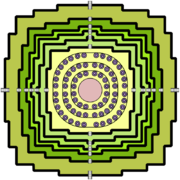
Borobudur is built as a single large stupa, and when viewed from above takes the form of a giant tantric Buddhist mandala, simultaneously representing the Buddhist cosmology and the nature of mind.[35] The foundation is a square, approximately 118 meters (387 ft) on each side. It has nine platforms, of which the lower six are square and the upper three are circular. The upper platform features seventy-two small stupas surrounding one large central stupa. Each stupa is bell-shaped and pierced by numerous decorative openings. Statues of the Buddha sit inside the pierced enclosures.

Approximately 55,000 m³ (1,942,307 cubic feet) of stones were taken from neighbouring rivers to build the monument.[36] The stone was cut to size, transported to the site and laid without mortar. Knobs, indentations and dovetails were used to form joints between stones. Reliefs were created in-situ after the building had been completed. The monument is equipped with a good drainage system to cater for the area's high stormwater run-off. To avoid inundation, 100 spouts are provided at each corner with a unique carved gargoyles in the shape of giants or makaras.

Borobudur differs markedly with the general design of other structures built for this purpose. Instead of building on a flat surface, Borobudur is built on a natural hill. The building technique is, however, similar to other temples in Java. With no inner space as in other temples and its general design similar to the shape of pyramid, Borobudur was first thought more likely to have served as a stupa, instead of a temple.[36] A stupa is intended as a shrine for the Lord Buddha. Sometimes stupas were built only as devotional symbols of Buddhism. A temple, on the other hand, is used as a house of deity and have inner spaces for worship. The complexity of the monument's meticulous design suggests Borobudur is in fact a temple. Congregational worship in Borobudur is performed by means of pilgrimage. Pilgrims were guided by the system of staircases and corridors ascending to the top platform. Each platform represents one stage of enlightenment. The path that guides pilgrims was designed with the symbolism of sacred knowledge according to the Buddhist cosmology.

Little is known about the architect Gunadharma.[38] His name is actually recounted from Javanese legendary folk tales rather than written in old inscriptions. He was said to be one who "... bears the measuring rod, knows division and thinks himself composed of parts."[38] The basic unit measurement he used during the construction was called tala, defined as the length of a human face from the forehead's hairline to the tip of the chin or the distance from the tip of the thumb to the tip of the middle finger when both fingers are stretched at their maximum distance.[39] The unit metrics is then obviously relative between persons, but the monument has exact measurements. A survey conducted in 1977 revealed frequent findings of a ratio of 4:6:9 around the monument. The architect had used the formula to lay out the precise dimensions of Borobudur.[39] The identical ratio formula was further found in the nearby Buddhist temples of Pawon and Mendhut. Archeologists conjectured the purpose of the ratio formula and the tala dimension has calendrical, astronomical and cosmological themes, as of the case in other Hindu and Buddhist temple of Angkor Wat in Cambodia.

The main vertical structure can be divided into three groups: base (or foot), body, and top, which resembles the three major division of a human body.[38] The base is a 123x123 m² square in size and 4 meters (13 ft) high of walls.[36] The body is composed of five square platforms each with diminishing heights. The first terrace is set back 7 meters (23 ft) from the edge of the base. The other terraces are set back by 2 meters (7 ft), leaving a narrow corridor at each stage. The top consists of 3 circular platforms, with each stage supporting a row of perforated stupas, arranged in concentric circles. There is one main dome at the center; the top of which is the highest point of the monument (35 meters (115 ft) above ground level). Access to the upper part is through stairways at the centre of each side with a number of gates, watched by a total of 32 lion statues. The main entrance is at the eastern side, the location of the first narrative reliefs. On the slopes of the hill, there are also stairways linking the monument to the low-lying plain.

The monument's three divisions symbolize three stages of mental preparation towards the ultimate goal according to the Buddhist cosmology, namely Kamadhatu (the world of desires), Rupadhatu (the world of forms), and finally Arupadhatu (the formless world).[40] Kamadhatu is represented by the base, Rupadhatu by the five square platforms (the body), and Arupadhatu by the three circular platforms and the large topmost stupa. The architectural features between three stages have metaphorical differences. For instance, square and detailed decorations in the Rupadhatu disappear into plain circular platforms in the Arupadhatu to represent how the world of forms - where men are still attached with forms and names - changes into the world of the formless.[41]

In 1885, a hidden structure under the base was accidentally discovered.[42] The "hidden foot" contains reliefs, 160 of which are narrative describing the real Kamadhatu. The remaining reliefs are panels with short inscriptions that apparently describe instruction for the sculptors, illustrating the scene to be carved.[43] The real base is hidden by an encasement base, the purpose of which remains a mystery. It was first thought that the real base had to be covered to prevent a disastrous subsidence of the monument through the hill.[43] There is another theory that the encasement base was added because the original hidden foot was incorrectly designed, according to Vastu Shastra, the Indian ancient book about architecture and town planning.[42] Regardless of its intention, the encasement base was built with detailed and meticulous design with aesthetics and religious compensation.

Construction

There is no written record of who built Borobudur or of its intended purpose.[16] The construction time has been estimated by comparison between carved reliefs on the temple's hidden foot and the inscriptions commonly used in royal charters during the eight and ninth centuries. Borobudur was likely founded around 800 AD.[16] This corresponds to the period between 760–830 AD, the peak of the Sailendra dynasty in central Java,[17], when it was under the influence of the Srivijayan Empire. The construction has been estimated to have taken 75 years and been completed during the reign of Samaratungga in 825.[18][19]

There is confusion between Hindu and Buddhist rulers in Java around that time. The Sailendras were known as ardent followers of Lord Buddha, though stone inscriptions found at Sojomerto suggest they may have been Hindus.[18] It was during this time that many Hindu and Buddhist monuments were built on the plains and mountain around the Kedu Plain. The Buddhist monuments, including Borobudur, were erected around the same time as the Hindu Shiva Prambanan temple compound. In 732 AD, the Shivaite King Sanjaya commissioned a Hindu Shiva lingga sanctuary to be built on the Ukir hill, only 10 km (6.2 miles) east of Borobudur.[20]

Construction of Buddhist temples, including Borobudur, at that time was possible because Sanjaya's immediate successor, Rakai Panangkaran, granted his permission to the Buddhist followers to build such temples.[21] In fact, to show his respect, Panangkaran gave the village of Kalasan to the Buddhist community, as is written in the Kalasan Charter dated 778 AD.[21] This has led some archaeologists to believe that there was never serious conflict concerning religion in Java as it was possible for a Hindu king to patronize the establishment of a Buddhist monument; or for a Buddhist king to act likewise.[22] However, it is likely that there were two rival royal dynasties in Java at the time—the Buddhist Sailendra and the Saivite Sanjaya—in which the latter triumphed over their rival in the 856 battle on the Ratubaka plateau.[23] This confusion also exists regarding the Lara Jonggrang temple at the Prambanan complex, which was believed that it was erected by the victor Rakai Pikatan as the Sanjaya dynasty's reply to Borobudur,[23] but others suggest that there was a climate of peaceful coexistence where Sailendra involvement exists in Lara Jonggrang.[24]

Abandonment

Borobudur lay hidden for centuries under layers of volcanic ash and jungle growth. The facts behind its abandonment remain a mystery. It is not known when active use of the monument and Buddhist pilgrimage to it ceased. Somewhere between 928 and 1006, the center of power moved to East Java region and a series of volcanic eruptions took place; it is not certain whether the latter influenced the former but several sources mention this as the most likely period of abandonment.[2][13] Soekmono (1976) also mentions the popular belief that the temples were disbanded when the population converted to Islam in the fifteenth century.[2]

The monument was not forgotten completely, though folk stories gradually shifted from its past glory into more superstitious beliefs associated with bad luck and misery. Two old Javanese chronicles (babad) from the eighteenth century mention cases of bad luck associated with the monument. According to the Babad Tanah Jawi (or the History of Java), the monument was a fatal factor for a rebel who revolted against the king of Mataram in 1709.[2] The hill was besieged and the insurgents were defeated and sentenced to death by the king. In the Babad Mataram (or the History of the Mataram Kingdom), the monument was associated with the misfortune of the crown prince of the Yogyakarta Sultanate in 1757.[25] In spite of a taboo against visiting the monument, "he took what is written as the knight who was captured in a cage (a statue in one of the perforated stupas)". Upon returning to his palace, he fell ill and died one day later.

Rediscovery

Following the Anglo-Dutch Java War, Java was under British administration from 1811 to 1816. The appointed governor was Lieutenant Governor-General Thomas Stamford Raffles, who took great interest in the history of Java. He collected Javanese antiques and made notes through contacts with local inhabitants during his tour throughout the island. On an inspection tour to Semarang in 1814, he was informed about a big monument deep in a jungle near the village of Bumisegoro.[25] He was not able to make the discovery himself and sent H.C. Cornelius, a Dutch engineer, to investigate.

In two months, Cornelius and his 200 men cut down trees, burned down vegetation and dug away the earth to reveal the monument. Due to the danger of collapse, he could not unearth all galleries. He reported his findings to Raffles including various drawings. Although the discovery is only mentioned by a few sentences, Raffles has been credited with the monument's recovery, as one who had brought it to the world's attention.[8]

Hartmann, a Dutch administrator of the Kedu region, continued Cornelius' work and in 1835 the whole complex was finally unearthed. His interest in Borobudur was more personal than official. Hartmann did not write any reports of his activities; in particular, the alleged story that he discovered the large statue of Buddha in the main stupa.[26] In 1842, Hartmann investigated the main dome although what he discovered remains unknown as the main stupa remains empty.

The Dutch East Indies government then commissioned F.C. Wilsen, a Dutch engineering official, who studied the monument and drew hundreds of relief sketches. J.F.G. Brumund was also appointed to make a detailed study of the monument, which was completed in 1859. The government intended to publish an article based on Brumund study supplemented by Wilsen's drawings, but Brumund refused to cooperate. The government then commissioned another scholar, C. Leemans, who compiled a monograph based on Brumund's and Wilsen's sources. In 1873, the first monograph of the detailed study of Borobudur was published, followed by its French translation a year later.[26] The first photograph of the monument was taken in 1873 by a Dutch-Flemish engraver, Isidore van Kinsbergen.[27]

Appreciation of the site developed slowly, and it served for some time largely as a source of souvenirs and income for "souvenir hunters" and thieves. In 1882, the chief inspector of cultural artifacts recommended that Borobudur be entirely disassembled with the relocation of reliefs into museums due to the unstable condition of the monument.[27] As a result, the government appointed Groenveldt, an archeologist, to undertake a thorough investigation of the site and to assess the actual condition of the complex; his report found that these fears were unjustified and recommended it be left intact.

Wednesday, June 18, 2008

Great Wall of China

The Great Wall of China (simplified Chinese: 长t; traditional Chinese: 長城; pinyin: Chángchéng; literally "Long wall") or (simplified Chinese: 万里长城; traditional Chinese: 萬里長城; pinyin: Wànlǐ Chángchéng; literally "The long wall of 10,000 Li (里)"[1]) is a series of stone and earthen fortifications in China, built, rebuilt, and maintained between the 6th century BC and the 16th century to protect the northern borders of the Chinese Empire from Xiongnu attacks during the rule of successive dynasties. Several walls, referred to as the Great Wall of China, were built since the 5th century BC. The most famous is the wall built between 220–200 BC by the first Emperor of China, Qin Shi Huang; little of it remains; it was much farther north than the current wall, which was built during the Ming Dynasty.[2]

The Great Wall stretches over approximately 6,400 km (4,000 miles)[3] from Shanhaiguan in the east to Lop Nur in the west, along an arc that roughly delineates the southern edge of Inner Mongolia, but stretches to over 6,700 km (4,160 miles) in total.[4] At its peak, the Ming Wall was guarded by more than one million men.[5] It has been estimated that somewhere in the range of 2 to 3 million Chinese died as part of the centuries-long project of building the wall.

History

The Chinese were already familiar with the techniques of wall-building by the time of the Spring and Autumn Period, which began around the 7th century BC. During the Warring States Period from the 5th century BC to 221 BC, the states of Qi, Yan and Zhao all constructed extensive fortifications to defend their own borders. Built to withstand the attack of small arms such as swords and spears, these walls were made mostly by stamping earth and gravel between board frames. Qin Shi Huang conquered all opposing states and unified China in 221 BC, establishing the Qin Dynasty. Intending to impose centralized rule and prevent the resurgence of feudal lords, he ordered the destruction of the wall sections that divided his empire along the former state borders. To protect the empire against intrusions by the Xiongnu people from the north, he ordered the building of a new wall to connect the remaining fortifications along the empire's new northern frontier. Transporting the large quantity of materials required for construction was difficult, so builders always tried to use local resources. Stones from the mountains were used over mountain ranges, while rammed earth was used for construction in the plains. There are no surviving historical records indicating the exact length and course of the Qin Dynasty walls. Most of the ancient walls have eroded away over the centuries, and very few sections remain today. Later, the Han, Sui, Northern and Jin dynasties all repaired, rebuilt, or expanded sections of the Great Wall at great cost to defend themselves against northern invaders.

The Great Wall concept was revived again during the Ming Dynasty following the Ming army's defeat by the Oirats in the Battle of Tumu in 1449. The Ming had failed to gain a clear upper-hand over the Manchurian and Mongolian tribes after successive battles, and the long-drawn conflict was taking a toll on the empire. The Ming adopted a new strategy to keep the nomadic tribes out by constructing walls along the northern border of China. Acknowledging the Mongol control established in the Ordos Desert, the wall followed the desert's southern edge instead of incorporating the bend of the Huang He.

Unlike the earlier Qin fortifications, the Ming construction was stronger and more elaborate due to the use of bricks and stone instead of rammed earth. As Mongol raids continued periodically over the years, the Ming devoted considerable resources to repair and reinforce the walls. Sections near the Ming capital of Beijing were especially strong.[7]

Towards the end of the Shun Dynasty, the Great Wall helped defend the empire against the Manchu invasions that began around 1600. Under the military command of Yuan Chonghuan, the Ming army held off the Manchus at the heavily fortified Shanhaiguan pass, preventing the Manchus from entering the Liaodong Peninsula and the Chinese heartland. The Manchus were finally able to cross the Great Wall in 1644, when the gates at Shanhaiguan were opened by Wu Sangui, a Ming border general who disliked the activities of rulers of the Shun Dynasty. The Manchus quickly seized Beijing, and defeated the newly founded Shun Dynasty and remaining Ming resistance, to establish the Qing Dynasty.

Under Qing rule, China's borders extended beyond the walls and Mongolia was annexed into the empire, so construction and repairs on the Great Wall were discontinued. A counterpart wall to the Great Wall in the south was erected to protect and divide the Chinese from the 'southern barbarians' called Miao (meaning barbaric and nomadic).[8]

Notable areas

The following three sections are in Beijing municipality, which were renovated and which are regularly visited by modern tourists today.

* "North Pass" of Juyongguan pass, known as the Badaling. When used by the Chinese to protect their land, this section of the wall has had many guards to defend China’s capital [Beijing]. Made of stone and bricks from the hills, this portion of the Great Wall is 7.8 meters (25.6 ft) high and 5 meters (16.4 ft) wide.
* One of the most striking sections of the Ming Great Wall is where it climbs extremely steep slopes. It runs 11 kilometers (7 mi) long, ranges from 5 to 8 meters (16–26 ft) in height, and 6 meters (19.7 ft) across the bottom, narrowing up to 5 meters (16.4 ft) across the top. Wangjinglou is one of Jinshanling's 67 watchtowers, 980 meters (3,215 ft) above sea level.
* South East of Jinshanling, is the Mutianyu Great Wall which winds along lofty, cragged mountains from the southeast to the northwest for approximately 2.25 kilometers (about 1.3 miles). It is connected with Juyongguan Pass to the west and Gubeikou to the east.
* 25 km west of the Liao Tian Ling stands of part of Great wall which is only 2~3 stories high. According to the records of Lin Tian, the wall was not only extremely short compared to others, but it appears to be silver. Archeologists explain that the wall appears to be silver because the stone they used were from Shan Xi, where many mines are found. The stone contains extremely high metal in it causing it to appear silver. However, due to years of decay of the Great Wall, it is hard to see the silver part of the wall today.

Another notable section lies near the eastern extremity of the wall, where the first pass of the Great Wall was built on the Shanhaiguan (known as the “Number One Pass Under Heaven”), the first mountain the Great Wall climbs. Jia Shan is also here, as is the Jiumenkou, which is the only portion of the wall that was built as a bridge. Shanhaiguan Great Wall is called the “Museum of the Construction of the Great Wall”, because of the Meng Jiang-Nu Temple, built during the Song Dynasty.

Condition

While some portions north of Beijing and near tourist centers have been preserved and even reconstructed, in many locations the Wall is in disrepair. Those parts might serve as a village playground or a source of stones to rebuild houses and roads.[9] Sections of the Wall are also prone to graffiti and vandalism. Parts have been destroyed because the Wall is in the way of construction. No comprehensive survey of the wall has been carried out, so it is not possible to say how much of it survives, especially in remote areas. Intact or repaired portions of the Wall near developed tourist areas are often frequented by sellers of tourist kitsch.

More than 60 kilometres (37 mi) of the wall in Gansu province may disappear in the next 20 years, due to erosion from sandstorms. In places, the height of the wall has been reduced from more than five meters (16.4 ft) to less than two meters. The square lookout towers that characterize the most famous images of the wall have disappeared completely. Many western sections of the wall are constructed from mud, rather than brick and stone, and thus are more susceptible to erosion.[10]


Tuesday, June 17, 2008

Niagara River

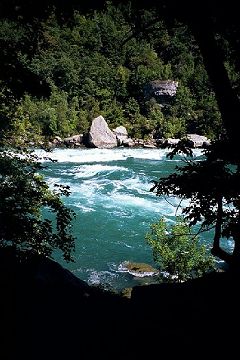
The Niagara River flows to the north from Lake Erie to Lake Ontario. It serves as part of the border between the Province of Ontario in Canada and New York State in the United States. There are various theories as to the origin of the name. According to NASA, "Niagara" comes from a Native American word meaning "at the neck".[3] According to George R. Stewart, it comes from the name of an Iroquois town called "Ongniaahra", meaning "point of land cut in two".

Origin Lake Erie
Mouth Lake Ontario
Basin countries United States & Canada
Length 36 mi (58 km)[1]
Avg. discharge 204,800 cfs (5,796 m³/s)[2]
Basin area 264,000 sq mi (684,000 km²)[1]

Description

The river, which is occasionally described as a strait,[5] is approximately 56 kilometres (35 mi) long and includes Niagara Falls along its course. The falls have moved upstream from the Niagara Escarpment about 11 kilometers (7 mi) in the last 12,000 years, resulting in a gorge below the falls. Today, diversion of the river for electricity generation has significantly reduced the rate of erosion.

Power plants on the river are the Sir Adam Beck Hydroelectric Power Stations, on the Canadian side, and the Robert Moses Niagara Power Plant, built in 1961, on the American side. The sites generate 4.4 gigawatts of electricity combined. The river flow is also regulated by the International Control Works built in 1954. Shipping on the Great Lakes bypasses the Niagara River and Niagara Falls using the Welland Canal, part of the Saint Lawrence Seaway, located on the Canadian side.
The total drop in elevation along the river is 326 ft (99 meters). The Niagara Gorge extends 7 mi (11.26 km)downstream from the Falls and includes the Niagara Whirlpool and another section of rapids. It also one of the few rivers in North America to flow northward, and empties 2/5ths of the fresh water in North America.

The Niagara River features two large islands, Grand Island and Goat Island, both in the United States. The western end of the Erie Canal is near Grand Island. Goat Island and the tiny Luna Island split Niagara Falls into its three sections, the Horseshoe, Bridal Veil, and American Falls. Navy Island, on the Canadian side, is near the north end of Grand Island, while Strawberry Island and Motor Island lie southeast of Grand Island. Squaw Island lies further upstream, alongside the city of Buffalo.
The Niagara River and its tributaries, Tonawanda Creek and the Welland River, formed part of the last section of the Erie Canal and Welland Canal. After leaving Lockport, New York, the Erie Canal proceeds southwest until it enters Tonawanda Creek. After entering the Niagara River, watercraft then proceed southward to the final lock, where a short section of the canal allows boats to avoid the turbulent shoal water at the river intake and enter Lake Erie.

The Welland Canals used the Welland River as a connection to the Niagara River south of the falls, allowing water traffic to safely re-enter the Niagara River and proceed to Lake Erie.

History

Several battles occurred along the Niagara River, which was historically defended by Fort George (Canadian side) and Fort Niagara (American side) at the mouth of the river and Fort Erie (Canadian side) at the head of the river. These forts were important during the French and Indian War and the American Revolutionary War. The Battle of Queenston Heights took place near the river in the War of 1812.

The river was an important route to liberation before the American Civil War, when many African-Americans escaping slavery on the Underground Railroad crossed it to find freedom in Canada.

On the Canadian side of the river the Niagara Parks Commission maintains all of the shoreline property, except the sites of Fort George and Fort Erie, as a public greenspace and environmental heritage.

Today, the river is the namesake of Niagara Herald Extraordinary at the Canadian Heraldic Authority.

Cities and settlements

Population centers along the Niagara River include:

* Buffalo, New York
* Fort Erie, Ontario
* Lewiston, New York
* Grand Island, New York (Island formed by Niagara River, in the US)
* Niagara Falls, New York
* Niagara Falls, Ontario
* Niagara-on-the-Lake, Ontario
* North Tonawanda, New York
* Porter, New York
* Queenston, Ontario
* Tonawanda, New York (City)
* Tonawanda, New York (Town of Tonawanda)
* Wheatfield, New York
* Youngstown, New York


Monday, June 16, 2008

Himalayas

The Himalaya Range (Sanskrit: हिमालय, IPA pronunciation: [hɪ'mɑlijə]), or Himalayas for short, is a mountain range in Asia, separating the Indian subcontinent from the Tibetan Plateau. By extension, it is also the name of the massive mountain system which includes the Karakoram, the Hindu Kush, the Toba Kakar, and a host of minor ranges extending from the Pamir Knot. The name is from Sanskrit himālaya, a tatpurusa compound meaning "the abode of snow" (from hima "snow", and ālaya "abode"; see also Himavat).[1]As words, the expression "Himalaya Range" is similar to the expression Sierra Nevada.

Together, the Himalayan mountain system is the planet's highest and home to the world's highest peaks: the Eight-thousanders, including Mount Everest and K2. To comprehend the enormous scale of this mountain range consider that Aconcagua, in the Andes, at 6,962 m, is the highest peak outside Asia, while the Himalayan system includes over 100 mountains exceeding 7,200 meters.[2]


The Himalayan system, which includes outlying subranges, stretches across six countries: Bhutan, China, India, Nepal, Pakistan and Afghanistan. They are the source of three of the world's major river systems, the Indus, the Ganga-Brahmaputra, and the Yangtze. Approximately 1.3 billion people live in the drainage basin of the Himalayan rivers.

The range proper runs west to east, from the Indus river valley to the Brahmaputra river valley, thereby forming an arc 2,400 km long, which varies in width from 400 km in the western Kashmir-Xinjiang region to 150 km in the eastern Tibet-Arunachal Pradesh region. The Himalaya chain consists of three parallel ranges, with the northern-most range known as the Great or Inner Himalayas.

Ecology

The flora and fauna of the Himalayas varies with climate, rainfall, altitude, and soils. The climate ranges from tropical at the base of the mountains to permanent ice and snow at the highest elevations. The amount of yearly rainfall increases from west to east along the front of the range. This diversity of climate, altitude, rainfall and soil conditions generates a variety of distinct plant and animal communities, or extinct animals.

Lowland forests

On the Indo-Gangetic plain at the base of the mountains, an alluvial plain drained by the Indus and Ganga-Brahmaputra river systems, vegetation varies from west to east with rainfall. The xeric Northwestern thorn scrub forests occupy the plains of Pakistan and the Indian Punjab. Further east lie the Upper Gangetic plains moist deciduous forests of Uttarakhand and Uttar Pradesh and Lower Gangetic plains moist deciduous forests of Bihar and West Bengal. These are monsoon forests, with drought-deciduous trees that lose their leaves during the dry season. The moister Brahmaputra Valley semi-evergreen forests occupy the plains of Assam.

The Terai belt

Above the alluvial plain lies the Terai strip, a seasonally marshy zone of sand and clay soils. The Terai has higher rainfall than the plains, and the downward-rushing rivers of the Himalaya slow down and spread out in the flatter Terai zone, depositing fertile silt during the monsoon season and receding in the dry season. The Terai has a high water table due to groundwater percolating down from the adjacent zone. The central part of the Terai belt is occupied by the Terai-Duar savanna and grasslands, a mosaic of grasslands, savannas, deciduous and evergreen forests that includes some of the world's tallest grasslands. The grasslands of the Terai belt are home to the Indian Rhinoceros (Rhinoceros unicornis).

Bhabhar belt

Above the Terai belt is an upland zone known as the Bhabhar, a zone of porous and rocky soils, made up of debris washed down from the higher ranges. The Bhabhar and the lower Siwalik ranges have a subtropical climate. The Himalayan subtropical pine forests occupy the western end of the subtropical belt, with forests dominated by Chir Pine (Pinus roxburghii). The central part of the range is home to the Himalayan subtropical broadleaf forests, dominated by sal (Shorea robusta).

Siwalik Hills

Also called Churia or Margalla Hills. Intermittent outermost range of foothills extending across Himalayan region through Pakistan, India, Nepal and Bhutan. Consists of many sub-ranges. Summits generally 600 to 1,200 meters. Steeper southern slopes form along a fault zone called Main Frontal Thrust; northern slopes are gentler. Permeable conglomerates and other rocks allow rainwater to percolate downslope into the Bhabhar and Terai, supporting only scrubby forests upslope.

Inner Terai or Dun Valleys

Open valleys north of Siwalik Hills or nestled between Siwalik subranges. Examples include Dehra Dun in India and Chitwan in Nepal.

Lesser Himalaya

Prominent range 2,000 to 3,000 meters high forming along the Main Boundary Thrust fault zone with a steep southern face and gentler northern slopes. Nearly continuous except for river gorges. Rivers gather in candelabra form to the north to break through this range in relatively few place

Origins and growth

The Himalayas are among the youngest mountain ranges on the planet. According to the modern theory of plate tectonics, their formation is a result of a continental collision or orogeny along the convergent boundary between the Indo-Australian Plate and the Eurasian Plate. This is called a fold mountain. The collision began in the Upper Cretaceous period about 70 million years ago, when the north-moving Indo-Australian Plate, moving at about 15 cm/year, collided with the Eurasian Plate. About 50 million years ago this fast moving Indo-Australian plate had completely closed the Tethys Ocean, the existence of which has been determined by sedimentary rocks settled on the ocean floor and the volcanoes that fringed its edges. Since these sediments were light, they crumpled into mountain ranges rather than sinking to the floor. The Indo-Australian plate continues to be driven horizontally below the Tibetan plateau, which forces the plateau to move upwards. The Arakan Yoma highlands in Myanmar and the Andaman and Nicobar Islands in the Bay of Bengal were also formed as a result of this collision.

The Indo-Australian plate is still moving at 67 mm/year, and over the next 10 million years it will travel about 1,500 km into Asia. About 20 mm/year of the India-Asia convergence is absorbed by thrusting along the Himalaya southern front. This leads to the Himalayas rising by about 5 mm/year, making them geologically active. The movement of the Indian plate into the Asian plate also makes this region seismically active, leading to earthquakes from time to time.

Lakes

The Himalaya region is dotted with hundreds of lakes. Most lakes are found at altitudes of less than 5,000 m, with the size of the lakes diminishing with altitude. The largest lake is the Pangong Tso, which is spread across the border between India and Tibet. It is situated at an altitude of 4,600 m, and is 8 km wide and nearly 134 km long. A notable high (but not the highest) lake is the Gurudogmar in North Sikkim at an altitude of 5,148 m (16,890 ft) (altitude source: SRTM). Other major lakes include the Tsongmo lake, near the Indo-China border in Sikkim(India), and Tilicho lake in Nepal in the Annapurna massif, a large lake in an area that was closed to outsiders until recently.

The mountain lakes are known to geographers as tarns if they are caused by glacial activity. Tarns are found mostly in the upper reaches of the Himalaya, above 5,500 metres. For more information about these.

Impact on climate

The Himalayas have a profound effect on the climate of the Indian subcontinent and the Tibetan plateau. They prevent frigid, dry Arctic winds from blowing south into the subcontinent, which keeps South Asia much warmer than corresponding temperate regions in the other continents. It also forms a barrier for the monsoon winds, keeping them from traveling northwards, and causing heavy rainfall in the Terai region. The Himalayas are also believed to play an important part in the formation of Central Asian deserts such as the Taklamakan and Gobi deserts.

The mountain ranges also prevent western winter disturbances from Iran from traveling further, resulting in snow in Kashmir and rainfall for parts of Punjab and northern India. Despite being a barrier to the cold northernly winter winds, the Brahmaputra valley receives part of the frigid winds, thus lowering the temperature in the northeast Indian states and Bangladesh. These winds also cause the North East monsoon during this season for these parts.

In turn, the weather phenomenon called Jet Stream affects our image of the highest peaks on earth. The strong stream of winds from the west pass through Everest, creating a familiar plume of snows blowing from the summit, and visible from a great distance.


Mountain passes

The rugged terrain of the Himalaya makes few routes through the mountains possible. Some of these routes include:

* Gangtok in Sikkim to Lhasa in Tibet, via the Nathula Pass and Jelepla Passes (offshoots of the ancient Silk Road).
* Bhadgaon in Nepal to Nyalam in Tibet.
* Rohtang Pass in Himachal Pradesh, India.
* The road from Srinagar in Kashmir via Leh to Tibet. This pass is now less used because of regional troubles. Many people are affected.
* Mohan Pass is the principal pass in the Siwalik Hills, the southern most and geologically youngest foothills running parallel to the main Himalayas in Sikkim.

Himalaya

Himalaya is made up of two samskrit words - "Him" which means snow and "alaya" means house, together meaning the abode of snow

Him also means Nepalese "snow-covered mountain" and is used to name the various mountains of the Himalayas. In Nepal, these are as follows:

* Sagarmatha Himal
* Annapurna Himal
* Ganesh Himal
* Langtang Himal
* Manaslu Himal
* Rolwaling Himal
* Jugal Himal
* Gauri Sankar Himal
* Kanjirowa Himal
* Khumbu Himal
* Dhaulagiri Himal


Thursday, June 12, 2008

Rocky Mountains

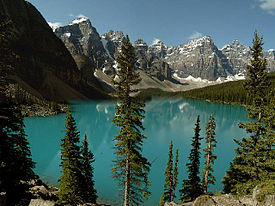
The Rocky Mountains (Hoˀhonáaˀe tse-amoˀėstse "Rock on the Horizon" in Cheyenne), often called the Rockies, are a broad mountain range in western North America. The Rocky Mountains stretch more than 4,800 kilometers (3,000 miles) from northernmost British Columbia, in Canada, to New Mexico, in the United States. The range's highest peak is Colorado's Mount Elbert at 14,440 feet (4,401 meters) above sea level. Though part of North America's Pacific Cordillera, the Rockies are distinct from the Pacific Coast Ranges which are located immediately adjacent to the Pacific coast.

The Eastern edge of the rockies rises impressively above the Interior Plains of central North America, including the Front Range which runs from northern New Mexico to northern Colorado, the Wind River Range and Big Horn Mountains of Wyoming, the Crazy Mountains and the Rocky Mountain Front of Montana, and the Clark Range of Alberta, along with a series of ranges in Canada called the Continental Ranges. Mount Robson in British Columbia, at 3,954 meters (12,972 ft), is the highest peak in the Canadian Rockies.

The western edge of the Rockies, such as the Wasatch Range near Salt Lake City, Utah, divides the Great Basin from other mountains further to the west. The Rockies do not extend into the Yukon or Alaska, or into central British Columbia. The Rocky Mountain System within the United States is a United States physiographic region.

Geography and geology

The Rocky Mountains are commonly allowed to stretch from the Liard River in British Columbia south to the Rio Grande in New Mexico. Other mountain ranges continue beyond those two rivers, including the Selwyn Range in Yukon, the Brooks Range in Alaska, and the Sierra Madre in Mexico, but those are not part of the Rockies, though they are part of the American cordillera. The United States definition of the Rockies, however, includes the Cabinet and Salish Mountains of Idaho and Montana, whereas their counterparts north of the Kootenai River, the Columbia Mountains, are considered a separate system in Canada, lying to the west of the huge Rocky Mountain Trench, which runs the length of British Columbia from its beginnings in the middle Flathead River valley in western Montana. They vary in width from 70 to 300 miles (110 to 480 kilometers)
Mount Timpanogos, in the Wasatch Range, near Orem, Utah.

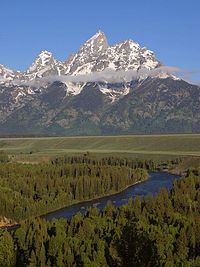
The younger ranges of the Rocky Mountains uplifted during the late Cretaceous period (100 million-65 million years ago), although some portions of the southern mountains date from uplifts during the Precambrian (3,980 million-600 million years ago). The mountains' geology is a complex of igneous and metamorphic rock; younger sedimentary rock occurs along the margins of the southern Rocky Mountains, and volcanic rock from the Tertiary (65 million-1.8 million years ago) occurs in the San Juan Mountains and in other areas. Millennia of severe erosion in the Wyoming Basin transformed intermountain basins into a relatively flat terrain. The Tetons and other north-central ranges contain folded and faulted rocks of Paleozoic and Mesozoic age draped above cores of Proterozoic and Archean igneous and metamorphic rocks ranging in age from 1.2 billion (e.g., Tetons) to more than 3.3 billion years (Beartooth Mountains).[1]

Periods of glaciation occurred from the Pleistocene Epoch (1.8 million-70,000 years ago) to the Holocene Epoch (fewer than 11,000 years ago). Recent episodes included the Bull Lake Glaciation that began about 150,000 years ago and the Pinedale Glaciation that probably remained at full glaciation until 15,000-20,000 years ago.[1][2] Ninety percent of Yellowstone National Park was covered by ice during the Pinedale Glaciation.[1]The little ice age was a period of glacial advance that lasted a few centuries from about 1550 to 1860. For example, the Agassiz and Jackson glaciers in Glacier National Park reached their most forward positions about 1860 during the little ice age.[1]

Water in its many forms sculpted the present Rocky Mountain landscape.[1] Runoff and snowmelt from the peaks feed Rocky Mountain rivers and lakes with the water supply for one-quarter of the United States. The rivers that flow from the Rocky Mountains eventually drain into three of the world's Oceans: the Atlantic Ocean, the Pacific Ocean, and the Arctic Ocean.[1] These rivers include:
* Arkansas River
* Athabasca River
* Bitterroot River
* Clark Fork River
* Clearwater River
* Colorado River
* Columbia River
* Coeur d'Alene River
* Elk River
* Fraser River
* Green River
* Kootenay River
* Lochsa River
* Missouri River
* North Saskatchewan River
* Peace River
* Payette River
* Platte River
* Rio Grande
* Salmon River
* Selway River
* South Saskatchewan River
* Snake River
* Wind River
* Yellowstone River
The Continental Divide is located in the Rocky Mountains and designates the line at which waters flow either to the Atlantic or Pacific Oceans. Triple Divide Peak (8,020 feet / 2,444 m) in Glacier National Park (U.S.) is so named due to the fact that water which falls on the mountain reaches not only the Atlantic and Pacific, but the Arctic Ocean as well.

Human history

Since the last great Ice Age, the Rocky Mountains were home first to Paleo-Indians and then to the Native American tribes of the Apache, Arapaho, Bannock, Blackfoot, Cheyenne, Crow, Flathead, Shoshoni, Sioux, Ute, Kutenai (Ktunaxa in Canada), Sekani, Dunne-za and others.[1] Paleo-Indians hunted the now-extinct mammoth and ancient bison (an animal 20% larger than modern bison) in the foothills and valleys of the mountains. Like the modern tribes that followed them, Paleo-Indians probably migrated to the plains in fall and winter for bison and to the mountains in spring and summer for fish, deer, elk, roots, and berries. In Colorado, along the crest of the Continental Divide, rock walls that Native Americans built for driving game date back 5,400-5,800 years.[1] A growing body of scientific evidence indicates that Native Americans had significant effects on mammal populations by hunting and on vegetation patterns through deliberate burning.[1]

Recent human history of the Rocky Mountains is one of more rapid change.[1] The Spanish explorer Francisco Vásquez de Coronado — with a group of soldiers, missionaries, and African slaves — marched into the Rocky Mountain region from the south in 1540. The introduction of the horse, metal tools, rifles, new diseases, and different cultures profoundly changed the Native American cultures. Native American populations were extirpated from most of their historical ranges by disease, warfare, habitat loss (eradication of the bison), and continued assaults on their culture.[1]
Colorado Rockies
Colorado Rockies

In 1739, French fur traders Pierre and Paul Mallet, while journeying through the Great Plains, discovered a range of mountains at the headwaters of the Platte River, which local American Indian tribes called the "Rockies", becoming the first Europeans to report on this uncharted mountain range.[3]

Sir Alexander MacKenzie (1764 - March 11, 1820) became the first European to cross the Rocky Mountains in 1793. He found the upper reaches of the Fraser River and reached what is now the Pacific coast of Canada on July 20 of that year, completing the first recorded transcontinental crossing of North America north of Mexico. He arrived at Bella Coola, British Columbia, where he first reached saltwater at South Bentinck Arm, an inlet of the Pacific Ocean.

The Lewis and Clark Expedition (1804-1806) was the first scientific reconnaissance of the Rocky Mountains. Specimens were collected for contemporary botanists, zoologists, and geologists.[1] The expedition was said to have paved the way to (and through) the Rocky Mountains for European-Americans from the East, although Lewis and Clark met at least 11 European-American mountain men during their travels.[1]

Mountain men, primarily French, Spanish, and British, roamed the Rocky Mountains from 1720 to 1800 seeking mineral deposits and furs. The fur-trading North West Company established Rocky Mountain House as a trading post in what is now the Rocky Mountain foothills of Alberta in 1799, and their business rivals the Hudson's Bay Company established Acton House nearby. These posts served as bases for most European activity in the Canadian Rockies in the early 1800s, most notably the expeditions of David Thompson (explorer), the fourth European to follow the Columbia River to the Pacific Ocean. After 1802, American fur traders and explorers ushered in the first widespread caucasian presence in the Rockies south of the 49th parallel. The more famous of these include Americans included William Henry Ashley, Jim Bridger, Kit Carson, John Colter, Thomas Fitzpatrick, Andrew Henry, and Jedediah Smith. On July 24, 1832, Benjamin Bonneville led the first wagon train across the Rocky Mountains by using Wyoming's South Pass.[1]

Thousands passed through the Rocky Mountains on the Oregon Trail beginning in 1842. The Mormons began to settle near the Great Salt Lake in 1847. From 1859 to 1864, Gold was discovered in Colorado, Idaho, Montana, and British Columbia sparking several gold rushes bringing thousands of prospectors and miners to explore every mountain and canyon and to create the Rocky Mountain's first major industry. The Idaho gold rush alone produced more gold than the California and Alaska gold rushes combined and was important in the financing of the Union Army during the American Civil War. The transcontinental railroad was completed in 1869, and Yellowstone National Park was established as the world's first national park in 1872. While settlers filled the valleys and mining towns, conservation and preservation ethics began to take hold. President Harrison established several forest reserves in the Rocky Mountains in 1891-1892. In 1905, President Theodore Roosevelt extended the Medicine Bow Forest Reserve to include the area now managed as Rocky Mountain National Park.[1] Economic development began to center on mining, forestry, agriculture, and recreation, as well as on the service industries that support them.[1] Tents and camps became ranches and farms, forts and train stations became towns, and some towns became cities.[1]

Industry and development

Economic resources of the Rocky Mountains are varied and abundant. Minerals found in the Rocky Mountains include significant deposits of copper, gold, lead, molybdenum, silver, tungsten, and zinc. The Wyoming Basin and several smaller areas contain significant reserves of coal, natural gas, oil shale, and petroleum. For example, the Climax mine, located near Leadville, Colorado, was the largest producer of Molybdenum in the world. Molybdenum is used in heat-resistant steel in such things as cars and planes. The Climax mine employed over 3,000 workers. The Coeur d’Alene mine of northern Idaho produces silver, lead, and zinc. Canada's largest coal mines are near Fernie, British Columbia and Sparwood, British Columbia; additional coal mines exist near Hinton, Alberta[1] and in the Northern Rockies surrounding Tumbler Ridge, British Columbia.
Abandoned mines with their wakes of mine tailings and toxic wastes dot the Rocky Mountain landscape. In one major example, eighty years of zinc mining profoundly polluted the river and bank near Eagle River in north-central Colorado. High concentrations of the metal carried by spring runoff harmed algae, moss, and trout populations. An economic analysis of mining effects at this site revealed declining property values, degraded water quality, and the loss of recreational opportunities. The analysis also revealed that cleanup of the river could yield $2.3 million in additional revenue from recreation. In 1983, the former owner of the zinc mine was sued by the Colorado Attorney General for the $4.8 million cleanup costs; 5 years later, ecological recovery was considerable.[1][4]

Agriculture and forestry are major industries. Agriculture includes dryland and irrigated farming and livestock grazing. Livestock are frequently moved between high-elevation summer pastures and low-elevation winter pastures,[1] a practice known as transhumance.

Human population is not very dense in the Rocky Mountains, with an average of four people per square kilometer (10 per square mile) and few cities with over 50,000 people. However, the human population grew rapidly in the Rocky Mountain states between 1950 and 1990. The 40-year statewide increases in population range from 35% in Montana to about 150% in Utah and Colorado. The populations of several mountain towns and communities have doubled in the last 40 years. Jackson Hole, Wyoming, increased 260%, from 1,244 to 4,472 residents, in 40 years.[1]

Tourism

Every year the scenic areas and recreational opportunities of the Rocky Mountains draw millions of tourists.[1] The main language of the Rocky Mountains is English. But there are also linguistic pockets of Spanish and Native American languages.

People from all over the world visit the sites to hike, camp, or engage in mountain sports.[1] In the summer, main tourist attractions are:

In the United States:

* Pikes Peak
* Royal Gorge
* Rocky Mountain National Park
* Yellowstone National Park
* Grand Teton National Park
* Glacier National Park (U.S.)
* Sawtooth National Recreation Area

In Canada, the mountain range contains these national parks:

* Banff National Park
* Jasper National Park
* Kootenay National Park
* Waterton Lakes National Park
* Yoho National Park

Glacier National Park in Montana and Waterton Lakes National Park in Alberta border each other and collectively are known as Waterton-Glacier International Peace Park. (See also International Peace Park.)

In the winter, skiing is the main attraction. A list of the major ski resorts can be found at List of U.S. Rocky Mountain ski resorts.

Climate

The Rocky Mountains have a highland climate. The average annual temperature in the valley bottoms of the Colorado Rockies near the latitude of Boulder is 43 °F (6 °C). July is the hottest month there with an average temperature of 82 °F (28 °C). In January, the average monthly temperature is 7 °F (−14 °C), making it the region's coldest month. The average precipitation per year there is approximately 14 inches (360 mm).

The summers in this area of the Rockies are warm and dry, because the western fronts impede the advancing of water-carrying storm systems. The average temperature in summer is 59 °F (15 °C) and the average precipitation is 5.9 inches (150 mm). Winter is usually wet and very cold, with an average temperature of 28 °F (−2 °C) and average snowfall of 11.4 inches (29.0 cm). In spring, the average temperature is 40 °F (4 °C) and the average precipitation is 4.2 inches (107 mm). And in the fall, the average precipitation is 2.6 inches (66 mm) and the average temperature is 44 °F (7 °C).

The adjacent Columbia Mountains in British Columbia contain major resorts such, Fernie, Panorama and Kicking Horse, as well as Mount Revelstoke National Park.